
Contents
The capacity lie (and the maths behind it)
Buy a 10,000mAh power bank, look at your phone's 5,000mAh battery, and you would reasonably expect two full charges. You will get roughly one, plus a bit. Nobody is lying to you exactly - but the number on the box is measured somewhere the electricity never actually goes.
Here is what happens to the missing power:
- The rating is at cell voltage, not output voltage. That 10,000mAh is measured at the lithium cell's ~3.7V. Your phone charges at 5V or more, and stepping the voltage up means the amp-hours come down proportionally. This alone accounts for most of the gap.
- Conversion costs energy. Every voltage change loses some as heat - that's why a bank gets warm while working.
- Your phone loses some too. The receiving device has its own charging circuit, with its own losses.
- The bank runs itself. Displays, LEDs, and idle drain all take a small cut.
The conversion is simple: Wh = volts × amp-hours, using the ~3.7V cell voltage. So a 20,000mAh (20Ah) bank is about 3.7 × 20 = 74Wh. Keep that formula: it is the one the airline gate agent cares about.
Sizing: how big do you actually need?
The most common power bank mistake is not buying a bad one - it is buying one so heavy it lives in a drawer. Match the size to the actual failure you are trying to prevent:
| Capacity | ≈ Wh | Real phone charges | Weight | Best for |
|---|---|---|---|---|
| 5,000mAh | ~18Wh | ~0.5-0.7 | ~100g | Pocket top-up, keychain, "get me home" |
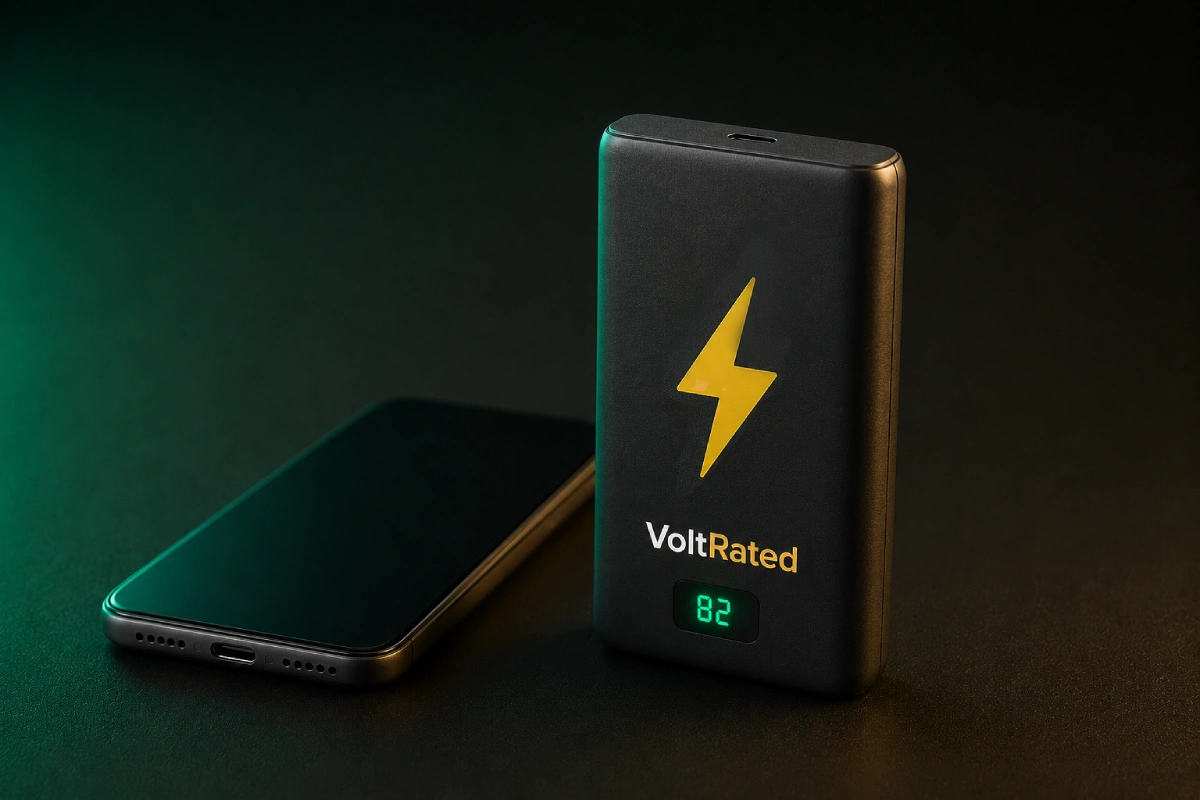
| 10,000mAh | ~37Wh | ~1-1.5 | ~200g | The sweet spot. Day out, commute, festival |
| 20,000mAh | ~74Wh | ~3-4 | ~400g | Weekend, multiple devices, light laptop use |
| 25-27,000mAh | ~92-100Wh | ~4-5 | ~600g | Laptop away from mains. At the airline ceiling. |
Note the last row: around 27,000mAh is where you hit the 100Wh airline limit. That is not a coincidence in product design - it is why so many "max size" travel banks cluster at 24,000-27,000mAh. Anything larger and you are into needing airline approval, or being refused.
Watts matter as much as mAh
Capacity tells you how much. Wattage tells you how fast - and it is the spec people skip. A huge bank with a weak output is a genuinely bad laptop charger:
- Under 20W - phone trickle. Fine for overnight, frustrating in an airport.
- 30W - fast-charges essentially any phone, and gently charges a small laptop. The everyday sweet spot.
- 65W - properly charges a mainstream laptop. The minimum worth calling a "laptop bank".
- 100-140W - full-speed charging for a large laptop, and normally several ports at once.
The trap: a 20,000mAh bank rated 18W will charge a laptop slower than the laptop consumes while you use it. The battery percentage goes down while plugged in. Capacity was never the issue - wattage was.
What to buy
Four categories cover nearly everyone. Prices are approximate US street and move constantly.
10,000mAh, ~30W USB-C PD
~$25-40Anker Nano / Ugreen 10,000mAh class · ~37Wh · 1-2 ports · often a built-in display
The bank that actually gets carried, which is the only spec that ultimately matters. It fits a jacket pocket, fully recharges a phone with room to spare, fast-charges at 30W, and is so far under airline limits that no rule change will ever touch it. Get one with a percentage display rather than four mystery LEDs - knowing you have 40% left is the difference between a useful tool and a gamble.
Pros
- Genuinely pocketable, so it comes with you
- Well under every airline limit
- 30W fast-charges any phone
Cons
- Only ~1 to 1.5 real phone charges
- Too slow for serious laptop charging
- Usually only one or two ports
5,000mAh keychain / built-in-connector bank
~$15-25~18Wh · built-in USB-C or magnetic · no cable needed
Not really a charger - an insurance policy. Half a phone charge, small enough to forget you're carrying, and the ones with a built-in connector mean there is no cable to leave at home. That last part matters more than the capacity: a 20,000mAh bank with no cable delivers exactly zero. Best as a second bank rather than your only one.
Pros
- Small enough that you always have it
- Built-in connector - nothing to forget
- Cheap
Cons
- Roughly half a phone charge, realistically
- Usually slow output
- Built-in connectors wear out
20,000mAh multi-port, 65-100W
~$50-80Ugreen Nexode / Anker Prime class · ~74Wh · 3+ ports · 65-100W out
The travel workhorse. Enough to keep two phones and a tablet alive for a weekend, or to give a laptop a real top-up, with the ports to do several at once. At ~74Wh it is still comfortably under the 100Wh airline ceiling. The cost is weight: around 400g is a noticeable brick in a bag, and it is the reason people who buy this size often end up buying a 10,000mAh one too.
Pros
- Charges several devices at once
- Enough wattage for a real laptop charge
- Still legal on flights without approval
Cons
- ~400g - you will notice it
- Wattage is often shared across ports
- Slow to refill unless input is 65W+
24-27,000mAh, 140W laptop bank
~$100-150Anker Prime / 737-class · ~92-100Wh · 140W PD 3.1 · at the airline ceiling
The maximum you can carry onto a plane without special permission, and priced accordingly. 140W means a large laptop charges at genuinely full speed, and there is enough capacity for most of a workday off-grid. Buy this if you actually work away from mains power. If you're honest and you mostly want peace of mind at an airport gate, the 10,000mAh pick does that job for a quarter of the price and a sixth of the weight.
Pros
- Full-speed charging for large laptops
- Maximum legal capacity for flying
- Fast recharge, typically 100W+ input
Cons
- Heavy (~600g) and expensive
- Right at the 100Wh limit - check the marking
- Overkill for phone-only users
Flying with a power bank in 2026
This changed materially this year, and it is the part of power bank ownership most likely to catch you out. Lithium battery incidents on aircraft have climbed steadily - the FAA has recorded 717 lithium battery incidents since it began tracking them in 2006, and nearly four in ten of those (281) involved portable battery packs. Reported events reached 97 in 2025, up from 89 the year before. Airlines have responded.
The FAA baseline (the rules that always apply)
- Carry-on only, always. Power banks are spare batteries. They may never go in checked baggage. If your bag gets gate-checked, take the bank out and keep it with you.
- 100Wh or less needs no approval. That's roughly 27,000mAh.
- 101-160Wh requires airline approval, limited to two per passenger.
- Over 160Wh is forbidden outright.
- Terminals must be protected from short circuit, and damaged or recalled batteries must not be carried at all.
What the airlines added in 2026
This is the crucial distinction: the FAA does not limit how many power banks you can bring, and does not ban them from overhead bins. Individual airlines now do both, and their rules differ from each other:
| Airline | Limit | Extra conditions |
|---|---|---|
| American | 2 chargers | From 1 May 2026. Must be in plain view (seat pocket, tray table) while in use; powered off otherwise |
| Delta | 2 chargers | Similar limit introduced in 2026; off during take-off and landing |
| Southwest | 1 charger | No power banks in overhead bins; must be visible when in use |
| Many non-US carriers | Varies | Bin bans and in-flight use bans are common; some prohibit charging in flight entirely |
The practical takeaway for buyers: a 10,000mAh bank sidesteps this entire mess. It is roughly 37Wh, nowhere near any limit, and small enough to keep in a seat pocket without a second thought. The regulatory pressure is all at the big end.
Magnetic and wireless banks
Magnetic banks that snap to the back of a phone are genuinely convenient - no cable, and you can use the phone while it charges. The trade-off is physics, and it is not small:
- Wireless charging is less efficient than a cable. A meaningful chunk of the energy becomes heat rather than charge, so you get noticeably fewer charges out of the same capacity.
- Heat is the thing that ages a battery. Wireless charging is warm charging, on both sides. Our guide on heat and battery life covers why that matters over the years.
- Qi2 improved things with proper magnetic alignment and 15W speeds, but a cable remains faster and cooler.
The sensible setup for most people: a wired USB-C bank as the main one, and a small magnetic bank as a convenience item if you like the form factor. Most magnetic banks include a USB-C port anyway - use it when speed matters.
What to avoid
- Impossible capacity claims. If a pocket-sized bank claims 50,000mAh for $15, the number is fiction. Capacity has a physical size and a real cost.
- No brand, no certification, no Wh marking. This is a lithium cell you keep in your bag and next to your bed. It is the wrong place to save eight dollars.
- Buying capacity you won't carry. The best bank is the one in your bag, not the biggest one in the drawer.
- Ignoring output wattage. A 20,000mAh 18W bank is not a laptop charger, whatever the listing implies.
- Assuming the bundled cable is good. Many banks ship a 60W or USB 2.0 cable that will throttle their own advertised output. See the cables guide.
- Swollen or damaged banks. A bank with a bulging case or a rattle is finished. Stop using it and recycle it properly - do not put it in a bag or on a plane.
Making it last
A power bank is a lithium battery and ages like every other one - the same rules from the charging guide apply:
- Don't store it flat or full for months. Around 50-60% is the kindest long-term storage state. A bank left at 0% in a drawer for a year may never wake up.
- Top it up every few months if it isn't in regular use. Self-discharge is slow but real.
- Keep it out of hot cars. A glovebox in summer is one of the worst places a lithium cell can live.
- Expect a few hundred cycles. Capacity fading over two to three years of regular use is normal wear, not a defect.
- Recycle it properly. It never goes in household waste. Most electronics retailers take batteries back.
⚡ How many charges will you really get?
Convert any bank's mAh rating into watt-hours - the number airlines actually regulate, and the only fair way to compare two banks.
Open: mAh to Wh Calculator →Bottom line: buy for the failure you actually have. For nearly everyone that is a phone at 8% in an airport, and the answer is a 10,000mAh 30W bank with a percentage display - pocketable, cheap, and immune to every airline rule change. Step up to 20,000mAh and 65W+ only if you genuinely work away from a wall, and check the watt-hour marking before you fly. Then pair it with a cable that can actually carry what it puts out, or you have bought wattage you'll never see.
FAQ
Why doesn't my 10,000mAh power bank charge my 5,000mAh phone twice?
Because the rated mAh is measured at the internal cell voltage of about 3.7V, while your phone charges at 5V or higher. Converting between those voltages loses energy as heat, and the bank's own electronics use some too. Real-world delivery is typically around 60 to 70 percent of the rating, so a 10,000mAh bank realistically returns about 6,000-7,000mAh to a phone - a little over one full charge for most phones, not two.
What size power bank can I take on a plane?
The FAA limit is 100 watt-hours (Wh) per battery, which is roughly 27,000mAh at typical cell voltage. Power banks up to 100Wh need no approval; 101-160Wh requires airline approval and is limited to two per person; above 160Wh is forbidden. Power banks are spare batteries, so they must travel in carry-on and never in checked baggage. Crucially, individual airlines now impose stricter limits than the FAA does, so check your carrier.
What are the new 2026 airline rules on power banks?
During 2026 all four major US airlines tightened their policies after a rise in lithium battery incidents. From 1 May 2026 American Airlines limits passengers to two portable chargers, which must stay in plain view such as a seat pocket or tray table while in use and be powered off otherwise. Delta introduced a similar two-charger limit, and Southwest allows one per passenger and bars power banks from overhead bins. These are airline policies rather than FAA rules, they differ by carrier, and they are still changing - check your airline before you fly.
How many watt-hours is my power bank?
Watt-hours = volts x amp-hours. For a power bank, use the internal cell voltage of about 3.7V, not the 5V output. So a 20,000mAh (20Ah) bank is roughly 3.7 x 20 = 74Wh, comfortably under the 100Wh airline limit. Most banks print the Wh figure on the casing, and if yours does, use that number rather than calculating it.
Can a power bank charge a laptop?
Yes, if it has USB-C Power Delivery output at a high enough wattage. Look for at least 60W output for a mainstream laptop and 100W or more for a larger one, plus enough capacity to be worth carrying - 20,000mAh or above. A 5W or 18W pocket bank will trickle a laptop so slowly it may not keep up with what the laptop is using, which is why the wattage rating matters as much as the capacity.
Capacity figures, watt-hour conversions, prices and model names are approximate ballparks that vary by product and change frequently. Airline policies described here are a July 2026 snapshot, differ between carriers, and are changing quickly - always confirm the current rules with your specific airline and check the marking on your own battery before travelling. This is general guidance, not an endorsement of any specific product, and not a substitute for official carrier or regulatory advice. VoltRated is independent and curation-based; we don't run our own lab tests.