Contents
What actually matters (and what doesn't)
Every spec sheet leads with a huge number. Most of them don't matter. These do:
1. Wh and W are different numbers, and people mix them up constantly
Watt-hours (Wh) is the size of the tank. Watts (W) is the size of the pipe. A 2000Wh station with a 300W inverter has a big tank and a garden hose - it will run a laptop for a week and refuse to start your microwave. A 300Wh station with a 1800W inverter is the opposite: it'll run the microwave, for about eight minutes.
So check both, in this order: the inverter watts must exceed everything you want running at once (or it just won't work at all), and then the watt-hours decide how long. Getting this backwards is the single most common buying mistake in this category.
2. LiFePO4 vs older lithium-ion - this is the cycle-life spec
Nearly every unit worth buying in 2026 uses LiFePO4 (lithium iron phosphate, "LFP"). It's typically rated for 3,000-6,000 cycles to 80% capacity, tolerates heat better, and is the more chemically stable option. The older NMC lithium-ion packs are usually rated in the hundreds of cycles.
The difference is not academic. At 500 cycles an NMC unit charged weekly is noticeably tired inside a decade; a 6,000-cycle LFP unit on the same schedule outlives the appliances plugged into it. LFP is heavier per watt-hour, which is the only reason a few ultralight budget models still ship NMC - Jackery's older Explorer 300 among them. If a listing doesn't say the chemistry, assume NMC and price it accordingly.
3. Surge watts, not just continuous
Anything with a motor or a compressor - fridge, pump, power tool, air compressor - draws a brief spike several times its running draw when it kicks on. A fridge that runs at 150W might surge past 1000W for a second. That's why the picks list continuous and surge (or "peak") separately, and why a 2000W/3000W-surge unit is a meaningfully different animal from a 2000W-flat one.
EcoFlow's X-Boost and similar features fudge this by lowering voltage to run over-spec resistive loads (kettles, heaters). It's genuinely useful for heating elements. It does not help motors.
4. Recharge speed is table stakes now
This is where the category moved fastest. Mid-range and premium units now routinely refill from a wall outlet in under two hours, and the 1kWh class is fighting over sub-hour times - Anker's C1000 Gen 2 holds a Guinness-verified record at about 49 minutes on its HyperFlash input. Independent testing of the previous C1000 measured about 83 minutes normally and 65 in its fast mode.
Worth knowing: fast charging is still harder on cells than slow charging, exactly as it is for the AA in your remote. Most of these units let you throttle the input in the app. If it's living in a closet waiting for an outage, there's no reason to ever use the fast mode.
5. Expandability - the spec that decides your next purchase
Several picks accept bolt-on expansion batteries: the Delta 3 Plus scales to about 5,120Wh, Bluetti's AC200L to about 8,192Wh, the C1000 doubles with one BP1000. This matters more than it sounds, because it's the difference between "buy a bigger one next year" and "buy another battery next year." Expansion packs are also proprietary - the platform you buy into now is the platform you're stuck with.
6. The rest: ports, UPS, noise, app
Quickly, because these are tiebreakers rather than dealbreakers. Ports: count the AC outlets and check for USB-C PD at 100W+ if you charge laptops. UPS/EPS switchover: most claim ~10-20ms, fine for a router or a desk PC, generally not certified for medical devices - check the manual, not the marketing. Noise: the fans on 2kWh+ units are audible under load; some brands are worse than others and reviewers usually mention it. App: EcoFlow's is the best in class and it isn't especially close.
How big do you actually need?
Two lines of arithmetic. Skip the brand comparison until you've done them. (Or let our power station sizing calculator do both lines for you.)
- Add the watts of everything running at once. That total, plus headroom for motor surge, is your minimum inverter rating. (Fridge ~150W running / ~1000W surge · laptop ~60W · CPAP ~40-60W · phone ~20W · LED lights ~10W each · microwave ~1000-1200W · coffee maker ~800-1200W · space heater ~1500W.)
- Multiply the running watts by the hours you need, then add ~15%. That's your watt-hours.
Worked example, the common one: a fridge cycling at an average ~50W over 24 hours (compressors don't run constantly) plus a few lights and phones is roughly 1,300-1,600Wh a day - but the surge means you still want a 1,500W+ inverter. That's why the 1kWh/2000W class is the popular answer: it covers a full day of the essentials, and two of them cover a weekend.
What to avoid
- No-name units with impossible watt-hour claims. The same inflation problem as those 9,900mAh AA cells. If a 1kWh-class unit from a brand you've never heard of is half the price of the four majors, the pack is the thing that's missing.
- NMC lithium-ion at LFP prices. Fine if it's genuinely cheap and light and you know what you're getting. Not fine at $400.
- "240V" claims that quietly need two units. Some 240V capability only exists when you buy a second station and a bonding cable. Read that footnote before budgeting.
- Buying on peak/surge watts alone. A big surge number on a small inverter is a spec-sheet flourish; the continuous rating is what runs your fridge all night.
- Buying at list price. This category discounts constantly and aggressively. Every price below is regularly beaten - see the note at the bottom.
Best small / grab-and-go
Under 300Wh, under 10 pounds, one hand. This class runs laptops, phones, drone batteries, a CPAP overnight, camp lights. It does not run a fridge, whatever the listing photo implies.
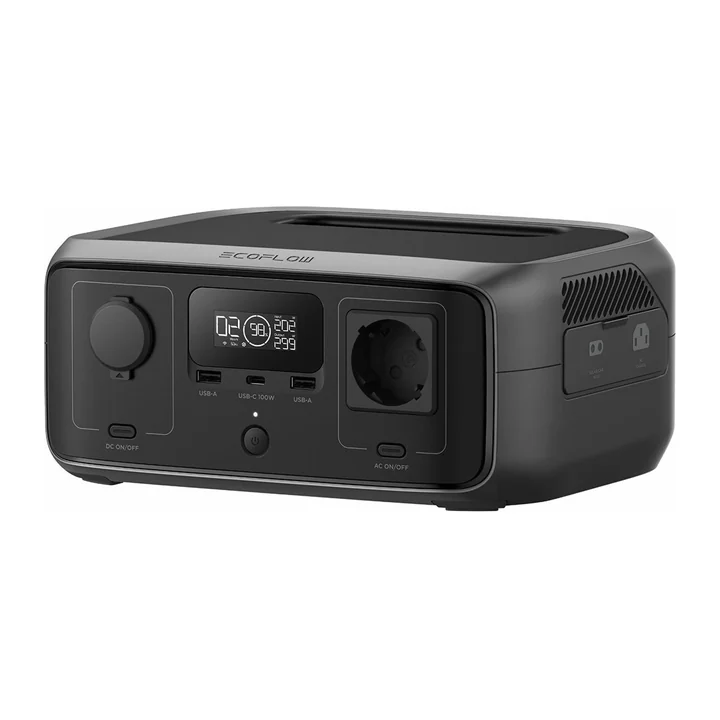
EcoFlow River 3
~$200-250245Wh · 300W continuous (600W X-Boost) · LiFePO4 · 7.8 lb · water-resistance rated
The one to grab for camping, tailgates and desk backup. It's light, it's cheap, it charges fast, and it's the only unit in its class with a water-resistance rating - which is why reviewers keep pointing it at outdoor use. 300W continuous is the honest limit: laptops, lights, a CPAP, a small TV. X-Boost will push a small resistive load past that, but don't buy it planning to.
Pros
- Genuinely light (7.8 lb) and one-hand portable
- LiFePO4 at a budget price - rare in this class
- Water-resistance rating; excellent app
- Fast recharge
Cons
- 300W ceiling rules out anything with a motor
- 245Wh is one laptop-day, not a weekend
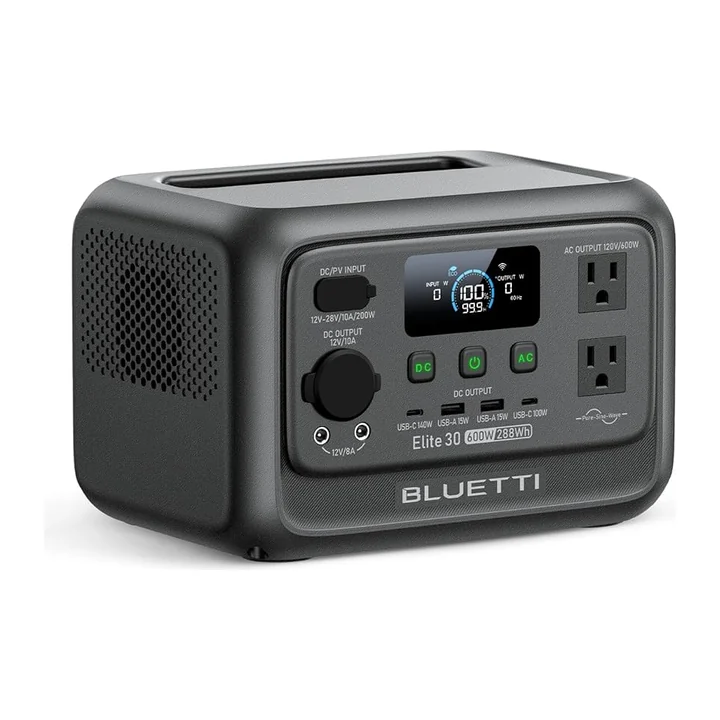
Bluetti Elite 30 V2 - more inverter for the money
~$220-300~288Wh · 600W continuous · LiFePO4 · lists ~$300, street price routinely lower
Double the inverter of the River 3 in a similar package, which widens what you can plug in without moving up a whole size class. It's near-permanently discounted below list - reviewers noted it at around $219 - so judge it on the street price, not the sticker. The pick if 300W feels tight but 1kWh feels silly.
Pros
- 600W inverter in a small-class unit
- LiFePO4 cycle life
- Frequently discounted well below list
Cons
- No water-resistance rating
- App and ecosystem behind EcoFlow's
Best 1kWh - the sweet spot
Around 1,000Wh and 1,800-2,000W. This is the class most people should buy: enough inverter for a fridge and a microwave, enough capacity for a day of essentials, and still liftable by one person. It's also the most competitive class in the category, which is good for you.
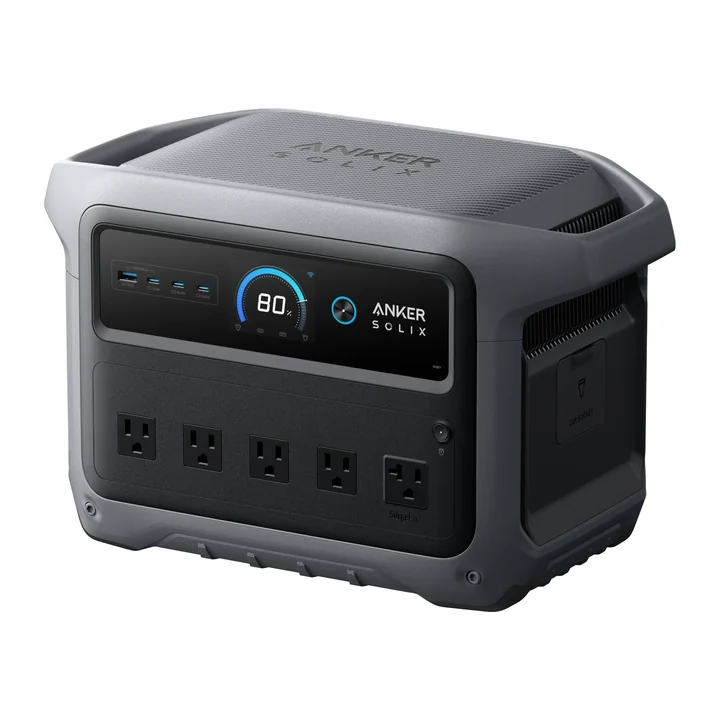
Anker Solix C1000 Gen 2
~$400-5001,056Wh · 2,000W continuous / 3,000W surge · LiFePO4 · ~49 min full recharge (HyperFlash) · expandable to ~2,112Wh
The one to buy if you don't want to think about it. It's the most inverter (2,000W) and the fastest recharge in the class, in the most compact body of the three, and it's routinely the cheapest of the majors - reviewers have flagged it under $400 on sale, which is where it stops being a comparison and starts being obvious. Outdoor Life named it the best power station for most people on exactly that basis: blackout, camping, or a plug away from an outlet.
The 3,000W surge is the part that matters day to day - it's what lets it start a fridge compressor without complaint. Add one BP1000 expansion battery and it doubles, which covers a two-day outage.
Pros
- 2,000W / 3,000W surge - runs a fridge and a microwave
- Fastest recharge in class (~49 min, Guinness-verified)
- Compact for its capacity; frequently the cheapest major
- LiFePO4, expandable to ~2.1kWh
Cons
- Expands once, not endlessly - Delta 3 Plus and AC200L go much further
- App is functional, not class-leading
- Model naming is a mess (see note below)
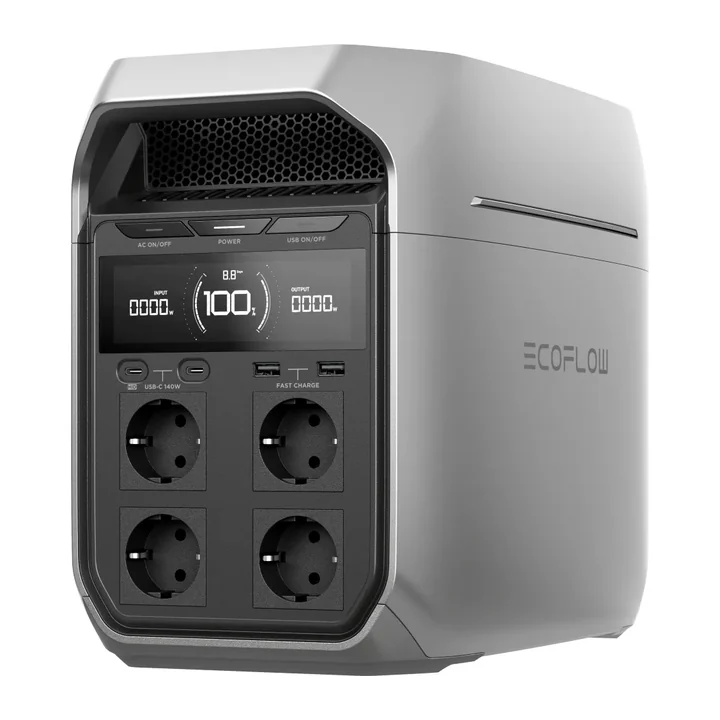
EcoFlow Delta 3 Plus - the features and the ecosystem
~$600-7001,024Wh · 1,800W continuous (2,400W X-Boost) · LiFePO4 · expandable to ~5,120Wh · ~56 min recharge
Scored top of the class in several 2026 comparisons, and the reason is breadth rather than any single number: a strong port selection, the best app in the category, high solar input, and expansion that runs all the way to 5,120Wh. If you suspect this is the start of a system rather than a one-off purchase - solar coming later, a second battery next year, smart-panel ambitions - this is the platform to buy into. EcoFlow remains the software leader here, and their ecosystem now reaches into smart panels and EV-to-home interfaces.
Against the C1000 Gen 2: less inverter (1,800W vs 2,000W), slightly slower recharge, and $150-250 more. You're paying for the ceiling, not the floor.
Pros
- Expandable to ~5,120Wh - grows with you
- Best-in-class app and ecosystem
- Excellent port selection and solar input
- Fast recharge, LiFePO4
Cons
- Noticeably pricier than the C1000
- 1,800W continuous is below the Anker
- X-Boost only helps resistive loads, not motors
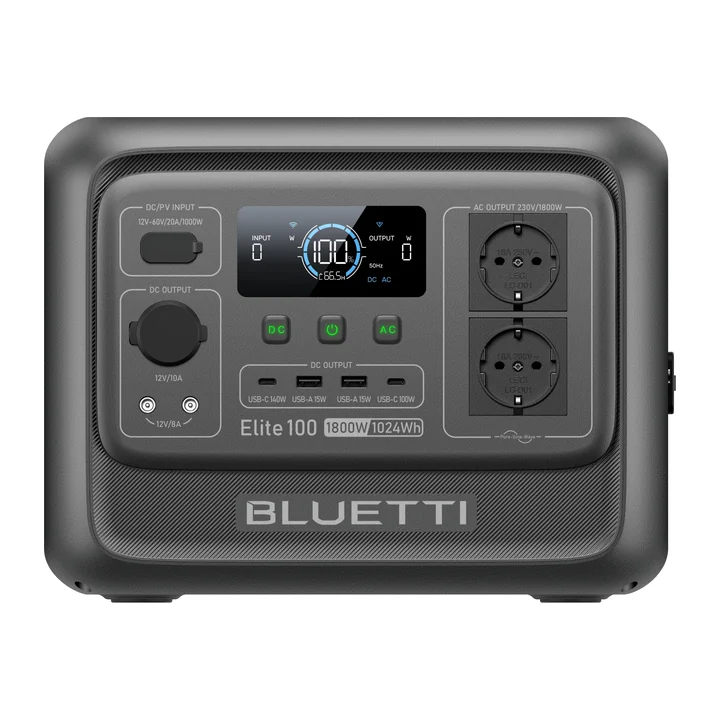
Bluetti Elite 100 V2 - the value play
~$450-5501,024Wh · 1,800W continuous · LiFePO4 (long-cycle) · frequently discounted
Splits the difference. Same 1kWh/1,800W formula as the Delta 3 Plus for meaningfully less money, with Bluetti's long cycle-life rating as the selling point. You give up EcoFlow's app polish and the deep expansion ceiling. The pick if you want the 1kWh class, know you'll never expand it, and would rather keep the $150.
Pros
- 1kWh/1,800W for less than the Delta 3 Plus
- Long LFP cycle-life rating
- Often heavily discounted
Cons
- App and ecosystem behind EcoFlow
- Slower to recharge than the Anker
Best 2kWh - fridge-for-days
Around 2,000Wh. This is the outage class: a fridge plus lights plus devices for a couple of days, or a long off-grid weekend. It's also where these stop being casually portable - expect 40-55 pounds and two hands.
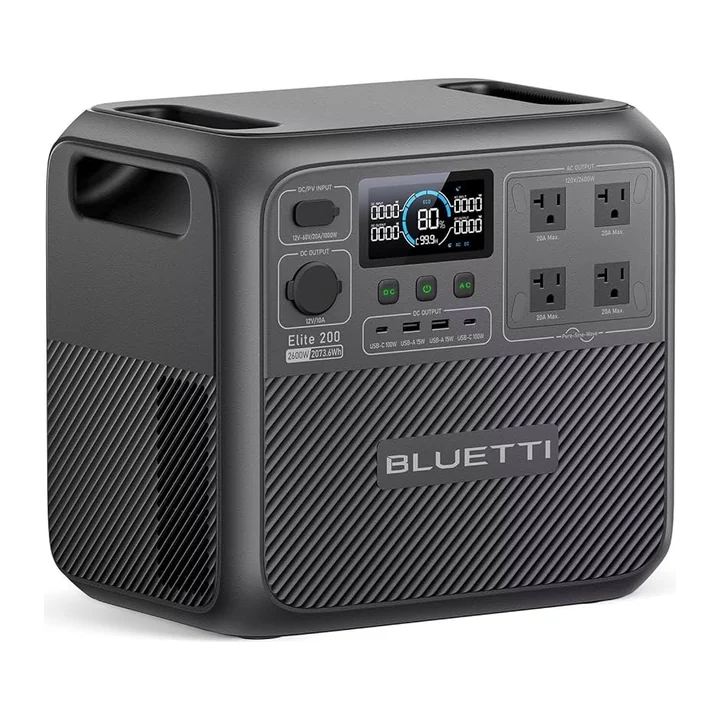
Bluetti Elite 200 V2
~$900-1,100~2,073Wh · 2,600W continuous · LiFePO4 rated 6,000+ cycles · fast AC recharge
The workhorse. Reviewers land on it for camping, home backup and job sites for a consistent set of reasons: it puts out more than its rivals (2,600W), charges from the wall faster than either, and does it in a smaller box. The headline spec is the 6,000+ cycle rating - the longest in this comparison. Charge it weekly and that's a century of cycles; it is, functionally, a buy-once unit.
2,600W continuous also changes what's possible: a fridge and a microwave and a power tool, rather than choosing.
Pros
- 6,000+ cycle rating - the longest here
- 2,600W continuous, most in class
- Fast wall recharge; compact for its capacity
- Bluetti's expansion ceiling is the highest (AC200L to ~8,192Wh)
Cons
- Heavy - around 53 lb, this is a two-hands unit
- App is fine, not EcoFlow-grade
- Fans are audible under real load
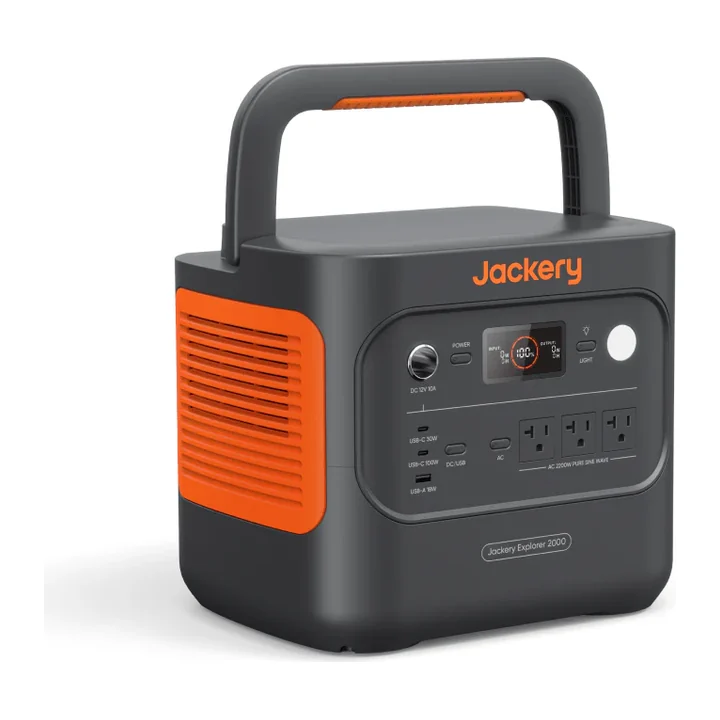
Jackery Explorer 2000 v2 - the light one
~$800-1,000~2,042Wh · 2,200W continuous · LiFePO4 · 39 lb
Jackery's argument in 2026 is power-to-weight, and it's a real one: 2,042Wh at 39 pounds - roughly double the capacity of a 1kWh Anker for about a third more weight. If the unit is going in and out of a car, up stairs, or into a campsite rather than living in a closet, that's the spec that will matter to you every single time you pick it up.
Less inverter than the Bluetti and a lower cycle rating, and Jackery's expansion story is weaker. But nothing else in the 2kWh class is this easy to carry.
Pros
- Best power-to-weight in the class (2,042Wh / 39 lb)
- 2,200W continuous is plenty for essentials
- LiFePO4; typically cheaper than the Elite 200 V2
Cons
- Lower cycle rating than Bluetti
- Less expandable ecosystem
- Slower to recharge than the leaders
Best whole-home / expandable
Past about 3kWh you've left "portable" behind - these are wheeled, they do 120V and 240V, and they're meant to be wired into your house through a transfer switch or smart panel by an electrician. Different product, different budget, and honestly a different guide. Two units define the tier:
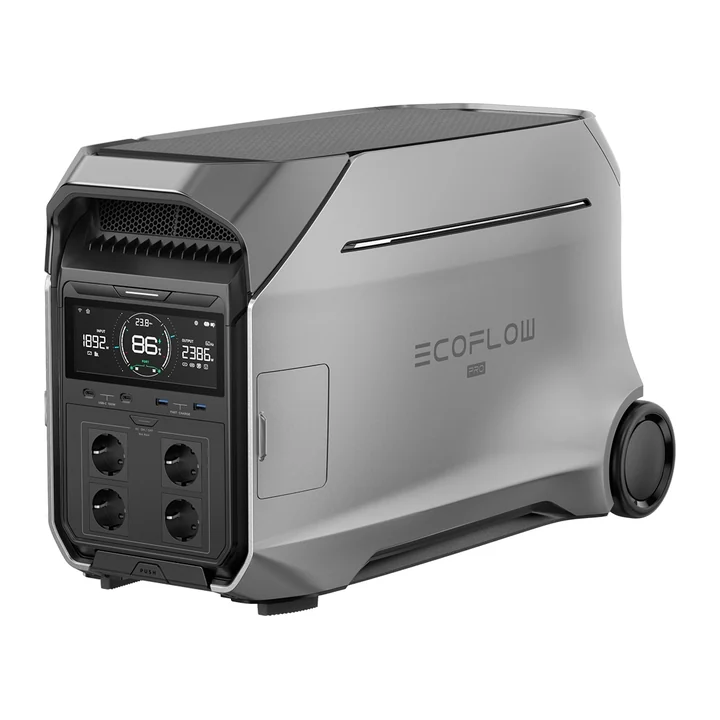
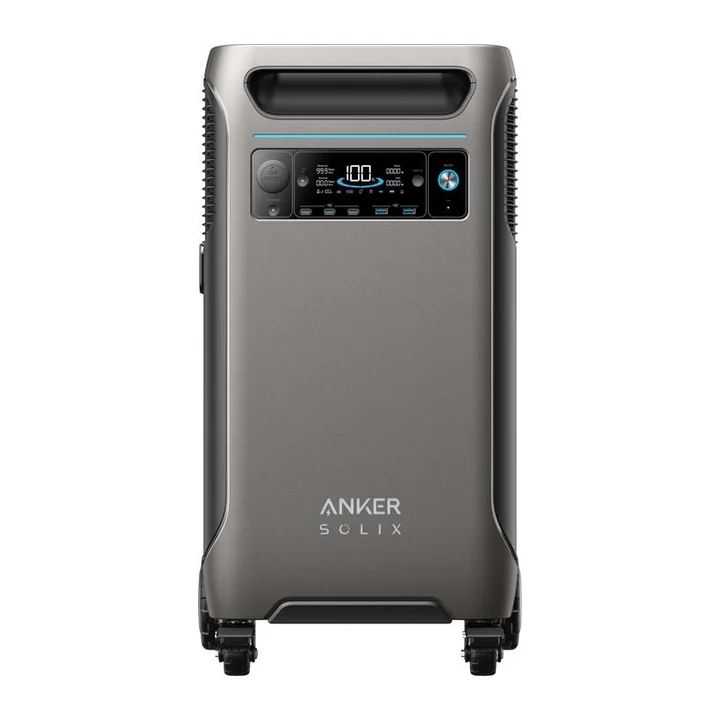
EcoFlow Delta Pro 3 / Anker Solix F3800
~$2,500-3,800~3,840-4,096Wh · 4,000-6,000W · 120V/240V split-phase · LiFePO4 · expandable into the tens of kWh
The Delta Pro 3 (~4,096Wh, 4,000W) is the one to get if you're already in EcoFlow's ecosystem or want their smart panel and app - and the older Delta Pro was measured at the fastest recharge of any unit in its size class at 153 minutes, which the Pro 3 continues. The Anker Solix F3800 (~3,840Wh, 6,000W) brings more inverter for heavier 240V loads. Both stack with expansion batteries into genuine home-backup territory.
Pros
- Real 240V split-phase output
- Expands into tens of kWh
- Can integrate with smart panels / transfer switches
Cons
- Costs several times a portable
- Panel integration needs a licensed electrician
- Wheeled, not carried - this is furniture
The four brands, decoded
Once you've picked a size, the brand mostly decides what the next five years look like:
- Anker Solix - the value and speed play. Best price-to-spec of the four, fastest recharge, compact. Ecosystem is the shallowest of the four but the units themselves are the easiest to just recommend.
- EcoFlow - the software and system play. Best app, deepest expansion, and the only one whose ecosystem meaningfully reaches into smart panels and EV-to-home. You pay for it.
- Bluetti - the longevity and headroom play. Highest cycle ratings, highest expansion ceiling, usually the most inverter watts per dollar. Software is the weak spot.
- Jackery - the portability play. Best power-to-weight, strong brand recall, widest retail availability. Weaker on expansion, and the older NMC models still in the lineup drag the average down - check the chemistry.
All four now build on LiFePO4 across their current lines, so the chemistry question has mostly stopped being a brand question and started being a model-age question.
All picks compared
| Model | Best for | Capacity | Output | Chemistry | ~Price |
|---|---|---|---|---|---|
| EcoFlow River 3 | Small / camping | 245Wh | 300W | LiFePO4 | $200-250 |
| Bluetti Elite 30 V2 | Budget small | ~288Wh | 600W | LiFePO4 | $220-300 |
| Anker Solix C1000 Gen 2 | Most people | 1,056Wh | 2,000W / 3,000W | LiFePO4 | $400-500 |
| EcoFlow Delta 3 Plus | Features / expansion | 1,024Wh | 1,800W | LiFePO4 | $600-700 |
| Bluetti Elite 100 V2 | 1kWh value | 1,024Wh | 1,800W | LiFePO4 | $450-550 |
| Bluetti Elite 200 V2 | Outages / longevity | ~2,073Wh | 2,600W | LiFePO4 6,000+ | $900-1,100 |
| Jackery Explorer 2000 v2 | Light 2kWh | ~2,042Wh | 2,200W | LiFePO4 | $800-1,000 |
| EcoFlow Delta Pro 3 | Whole-home | ~4,096Wh | 4,000W · 240V | LiFePO4 | $2,500-3,200 |
| Anker Solix F3800 | Heavy 240V | ~3,840Wh | 6,000W · 240V | LiFePO4 | $3,000-3,800 |
⚡ Size it before you buy
Tick off the appliances you need to run and our sizing calculator does the three numbers above for you - watt-hours, continuous watts and surge - with the fridge duty cycle handled properly.
Open the sizing calculator →Prices, model revisions and availability are approximate and change constantly in this category - discounts of 30-40% off list are routine, so confirm the current street price and the exact SKU before buying. Capacities and output figures are manufacturer specs; recharge times and comparative rankings reflect published independent testing (OutdoorGearLab, Outdoor Life, TechRadar and others) as of mid-2026. We don't run our own lab - we aggregate independent test data, manufacturer specs and community consensus. Double-check finer specs against the manufacturer's page for your region.