Contents
Does the brand even matter? Sort of.
Here's the mildly deflating truth: a charger doesn't care whose logo is stamped on your batteries, and the physics of filling a cell is the same everywhere. What separates the good brands from the sketchy ones isn't secret sauce - it's whether they do the boring fundamentals right: charging each slot independently, stopping at the right moment, and not cooking your cells with too much current. (We break those down in the best chargers guide.)
So why write about brands at all? Because each one has staked out a personality - a thing they're genuinely good at and a thing they don't bother with. Pick the brand whose personality matches your batteries, and you'll never overthink a charger purchase again. Pick wrong and you'll either overpay for a screen you never read, or underpay and slowly murder your cells. Let's find your match.
The three tiers, at a glance
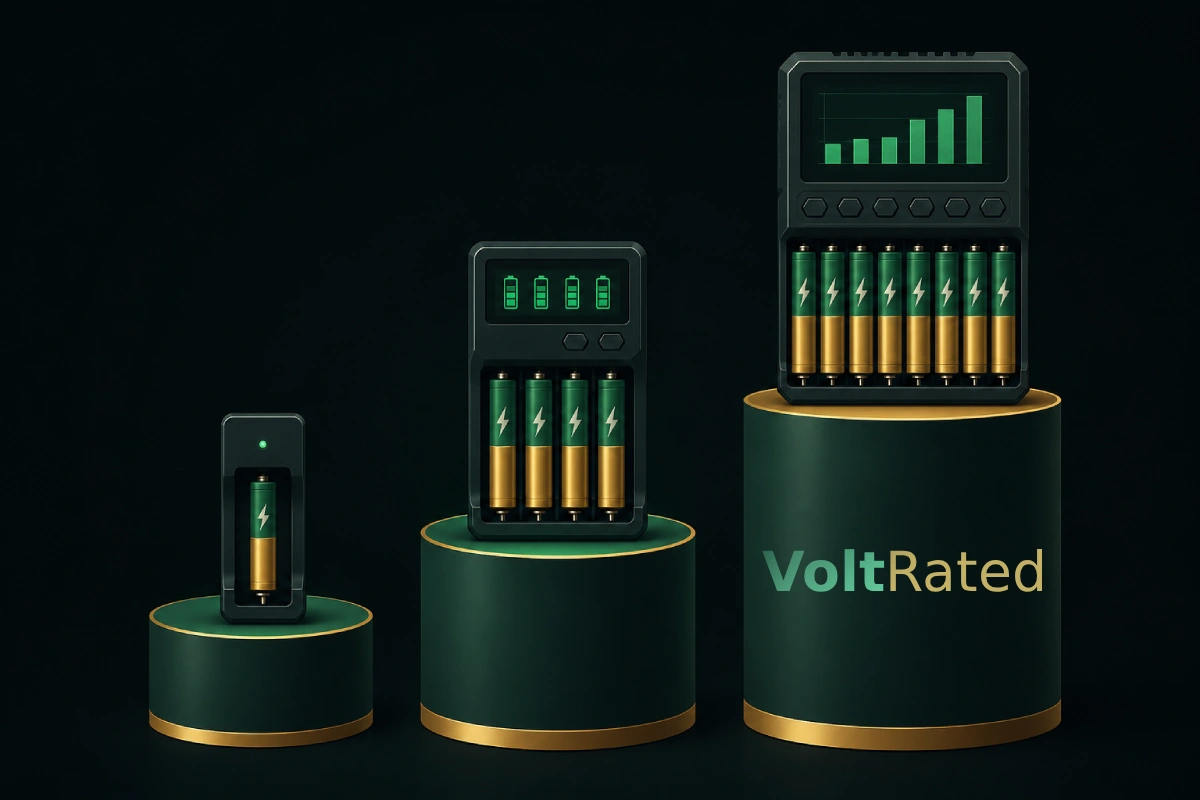
Charger brands sort neatly into three camps. Most people belong in the first one and can stop reading after it. No judgement - that's the healthy choice.
- Tier 1 - Household NiMH specialists. AA and AAA, plug it in, walk away. Panasonic/Eneloop, Duracell, Energizer, Amazon Basics, IKEA. Reliable, cheap, unglamorous.
- Tier 2 - Enthusiast multi-chemistry. The ones that also handle lithium cells (18650, 21700) and show you real numbers. XTAR and Nitecore live here.
- Tier 3 - Power-user and value tinkerers. Capacity analysis, high bay counts, every chemistry, manual control. Powerex/Maha, SkyRC, Miboxer, and the cheap-and-cheerful crowd (Vapcell, Liitokala).
Tier 1: the household NiMH crowd
These brands do one thing - charge your AA/AAA rechargeables - and the good ones do it flawlessly. If your batteries live in remotes, toys, game controllers, and the smoke detector, your search basically ends here.
Panasonic / Eneloop
~$18-45NiMH AA/AAA · true individual slot control · the community's default
The Toyota Corolla of chargers: nobody brags about it, everybody trusts it. Eneloop is simply Panasonic's rechargeable brand, so "Eneloop charger" and "Panasonic charger" are the same thing wearing different hats. Every slot charges independently, termination is reliable, and the BQ-CC55 refuels two AAs in about 90 minutes without abusing them. Want a screen and a USB output? Step up to the CC65. Want maximum cell lifespan? The gentle, slower CC17. The ceiling is low - no lithium, no capacity testing - but within its lane it never lets you down.
Loves
- Rock-solid reliability, widely available
- True independent slots even on the cheap models
- A model for every budget and speed
Limits
- AA/AAA NiMH only - no Li-ion, no C/D
- Even the fancy model won't measure true capacity
Duracell & Energizer
~$15-30NiMH AA/AAA · the drugstore-shelf option
The brands you already know from the disposable aisle, now selling rechargeables and the chargers to match (Duracell Ion Speed, Energizer Recharge Pro). They're fine. Genuinely fine. You'll find them at any store at 9pm when you need one now, they charge independently, and they shut off properly. They just don't do anything the Panasonic doesn't do better for similar money. Buy on convenience, not conviction.
Loves
- Available literally everywhere
- Often bundled with cells - one-box starter
- Trustworthy names, basic safety covered
Limits
- Slower and more basic than Eneloop kit
- Some retail chargers are paired-slot - check first
Amazon Basics, IKEA (LADDA) & other rebadgers
~$12-25NiMH AA/AAA · budget rebadged units
Here's an open secret: some of these cells are made in the same factories as the premium brands (IKEA's LADDA batteries are a beloved worst-kept secret among battery nerds). The chargers, though, are usually basic - fine for topping up cheap cells, not where you want your expensive ones. Great value if you know what you're getting; a false economy if the unit is paired-slot and quietly mismatches your batteries.
Loves
- Cheapest way into rechargeables
- LADDA cells punch way above their price
Limits
- Chargers are hit-or-miss on termination
- Little to no per-cell info; check for paired slots
Tier 2: the enthusiast multi-chemistry brands
The moment you own a flashlight, a power tool, an e-bike, or any device with a fat lithium cylinder in it, Tier 1 taps out. These brands charge both lithium and NiMH, per slot, and actually show you what's happening.
XTAR
~$15-60Li-ion 10440→21700 + NiMH AA/AAA/C · LCD with V/A/capacity/IR · runs cool
If Tier 2 had a class president, it'd be XTAR. They've been making lithium chargers since 2006 and it shows - the flashlight community reaches for them by reflex. You get Li-ion and NiMH in one box, per-slot detection, and an LCD reporting voltage, current, internal resistance, and measured capacity. The VC8 gives you eight bays for the 18650 hoarders; the compact four-bay models cover everyone else. The quiet superpower: in independent testing XTAR units run cooler than the comparable Nitecore, and heat is what ages cells. Nerd cred without the nerd tax.
Loves
- Li-ion + NiMH, per-slot, with real readouts
- Runs cool; USB-C input on newer models
- Capacity + internal-resistance testing built in
Limits
- Analyze features lighter than a true analyzer
- The 8-bay units are genuinely chunky
Nitecore
~$20-55Li-ion + NiMH, very broad cell sizes · fast (up to 3A/slot) · flashlight-ecosystem sibling
Nitecore is a flashlight brand that also makes chargers, and that heritage shows: they support an almost silly range of cell sizes and charge fast. If your gear is already Nitecore, their chargers slot right in and travel well (many run off USB). Two caveats keep it out of the top spot - they've slowed their pace of new charger releases, and their units run warmer than XTAR's while defaulting to aggressive currents. Dial the current down for small or NiMH cells and you'll be happy.
Loves
- Huge cell-size compatibility, fast charging
- Portable, USB-powered options for travel
- Perfect companion to a Nitecore flashlight kit
Limits
- Runs warmer than XTAR in independent tests
- Default current too high for AAA / small cells
Tier 3: the power-user and value tinkerers
Welcome to the deep end. These brands are for people who use the word "milliamp" in casual conversation - and, at the value end, for people who want that data without the premium price.
Powerex / Maha
~$50-90NiMH/NiCd only · true capacity analysis · break-in / refresh / manual current
The lab-coat brand. Powerex (made by Maha) doesn't do lithium and doesn't care to - it exists to tell you the truth about your NiMH cells. The legendary MH-C9000 discharges and recharges a cell to report its real measured capacity, runs a proper break-in cycle on new cells, and hands you manual current control per slot. If you've ever wanted to hunt down the one tired AA dragging your set down, this is the brand. Their high-bay MH-C800S handles eight cells for people running serious NiMH inventories.
Loves
- Accurate true-capacity measurement
- Break-in and refresh modes, per-slot manual current
- Bulletproof, industrial reputation
Limits
- No lithium support at all
- Pricey next to a plain smart charger
SkyRC
~$40-165Every chemistry · Bluetooth / PC graphing · full manual control
The programmable everything-charger brand. The MC3000 charges NiMH, Li-ion, LiFePO4, NiZn and more, with full manual control of every parameter and apps that plot the curves on your phone or PC. Independent tester HKJ (lygte-info.dk) rates it among the best non-professional chargers for cylindrical NiMH, partly because it revives high-resistance old cells that lesser chargers reject outright. It's overkill for normal humans and pure catnip for tinkerers. Their cheaper NC-series analyzers bring some of that data down to a friendlier price.
Loves
- Every chemistry, total manual control
- Graph logging via app / PC
- Revives cells other chargers give up on
Limits
- Expensive, bulky, real learning curve
- Flagship uses an external power brick
Miboxer
~$20-45Li-ion + NiMH · adjustable current · internal-resistance test · big informative LCD
The upstart that gives you 80% of the premium feature set for half the money. Miboxer chargers (the C4-12 and eight-bay C8 are the crowd favourites) swallow a wide mix of chemistries and sizes at once, let you set the charge current, test internal resistance, and put it all on a clear, borderline-overinformative display. Build quality and support aren't quite Powerex-grade, but for features-per-dollar, this is the brand punching hardest right now.
Loves
- Loads of features for the price
- Wide chemistry + size support, adjustable current
- Big, information-dense display
Limits
- Build and support below the premium brands
- Readings good, not laboratory-precise
Vapcell, Liitokala & the value crowd
~$15-55Li-ion + NiMH · analyze / refresh on some models · lots of features, patchier QC
The bargain bin of the enthusiast world - and we mean that with affection. The Vapcell S4 Plus does capacity analysis across both chemistries for well under premium money; Liitokala units are cheap and everywhere. The trade-off is consistency: quality control and support vary unit to unit, and the fancy readouts (especially internal resistance) are more "roughly right" than precise. Buy these knowing you're trading polish for price - eyes open, expectations calibrated.
Loves
- Analyze + refresh features at a low price
- Manual current control on better models
- Great for experimenting without commitment
Limits
- Variable quality control and support
- Precision readings are approximate at best
Which brand for a "pro" user?
"Pro" means different things to different people, so instead of crowning one winner, here's the honest decision tree. Find the sentence that sounds like you:
- "I want to know the true health of every cell." → Powerex/Maha for NiMH, or XTAR if you also need lithium. Capacity numbers are their whole reason for existing.
- "I live in 18650s and 21700s." → XTAR or Miboxer. Both handle big lithium cells with per-slot data, XTAR for polish, Miboxer for value.
- "My flashlight kit is Nitecore and I travel a lot." → Nitecore. Matching ecosystem, USB-powered, throw it in the bag.
- "I want to program every parameter and graph the curves." → SkyRC. Nothing else gives you this much rope.
- "It's honestly just AA and AAA around the house." → Panasonic/Eneloop. You are not a lesser person. You are a smart one. Stop overthinking it.
Every brand, side by side
| Brand | Tier | Chemistries | Standout trait | Best for | ~Price |
|---|---|---|---|---|---|
| Panasonic / Eneloop | Household | NiMH | Trusted default | Most people | $18-45 |
| Duracell / Energizer | Household | NiMH | Sold everywhere | Grab-and-go | $15-30 |
| Amazon Basics / IKEA | Household | NiMH | Cheapest entry | Budget starters | $12-25 |
| XTAR | Enthusiast | Li-ion + NiMH | Cool-running all-rounder | Power users | $15-60 |
| Nitecore | Enthusiast | Li-ion + NiMH | Broad sizes, portable | Flashlight kits | $20-55 |
| Powerex / Maha | Power user | NiMH only | True capacity analysis | NiMH health | $50-90 |
| SkyRC | Power user | Every chemistry | Programmable + graphs | Tinkerers | $40-165 |
| Miboxer | Value | Li-ion + NiMH | Features per dollar | Budget data | $20-45 |
| Vapcell / Liitokala | Value | Li-ion + NiMH | Cheap analyze features | Experimenters | $15-55 |
⚡ Still can't decide which brand fits your batteries?
Tell the Charger Finder what cells you own and it points you at the right kind of charger in three questions.
Open the Charger Finder →FAQ
Is a more expensive charger brand actually worth it?
Only if you use the extra features. For plain AA/AAA, a Panasonic/Eneloop does everything you need. Pay up for XTAR, Powerex or SkyRC when you want Li-ion support, real capacity testing, or manual control - otherwise you're buying a screen you'll never read.
Can I charge one brand of battery in another brand's charger?
Yes, as long as chemistry and size match. A charger doesn't read logos - a good NiMH charger happily charges Eneloop, Duracell, Amazon Basics, whatever. What matters is never putting a lithium cell in a NiMH-only charger, and using a sensible current. Brand loyalty is for the batteries' feelings, not the charger's.
Is Eneloop a different company from Panasonic?
No - Eneloop is Panasonic's rechargeable brand, so an "Eneloop charger" is a Panasonic charger. Suffixes like BQ-CC55E versus BQ-CC55 just mark the regional plug and packaging, not different internals.
Which brand for a power user?
Depends on the cells. Powerex/Maha for NiMH health testing, XTAR for lithium plus NiMH in one unit, Nitecore to match a flashlight kit, SkyRC for total programmable control. See the decision tree above.
VoltRated curates - we don't run our own lab. Brand assessments reflect current community consensus and independent testing (notably lygte-info.dk and eneloop101) as of mid-2026. Prices and model availability are approximate and change constantly; confirm on the manufacturer or retailer page before buying.